
The Hidden Cost of Roof Neglect:
A South African Property Owner’s Blueprint
for
Preventing Structural and Roofing Damage.
As a property owner in Gauteng, it is easy to adopt an “out of sight, out of mind” attitude toward your roof. Whether you own a beautiful residential home in Pretoria East, a commercial warehouse in Midrand, or a rental complex in Johannesburg, the roof quietly does its job day after day.
However, ignoring what happens above your head is one of the most expensive financial mistakes a South African property owner can make.
In the Highveld, our roofs are subjected to some of the most punishing climate conditions on earth. When a roof begins to fail, it does not always start with a dramatic, visible indoor flood. More often, it begins with a tiny, unnoticed 2mm breach. Over months, this small vulnerability lets in moisture that quietly rots your internal timber structure, destroys your ceiling boards, and compromises the integrity of your entire property.
This comprehensive blueprint will expose the true, hidden financial costs of roof neglect. It will teach you how Gauteng’s weather patterns systematically attack your building, and provide an actionable strategy to protect your real estate asset.
1. The Gauteng Weather Paradox:
How Local Climate Destroys Roofs
To understand why roof neglect is so costly, you must first understand the unique environmental forces at play in Gauteng. Unlike coastal regions that contend with constant salt spray and high humidity, the Highveld subjects properties to an entirely different set of structural stressors.
The Deadly “Thermal Shock” Cycle
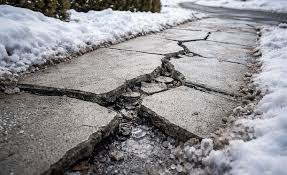
Gauteng experiences dramatic diurnal temperature swings, particularly during the dry winter months. It is entirely common to experience a crisp winter night dropping down to 2°C, followed by a bright, cloudless afternoon where the African sun bakes your roof surface up to 25°C.
This rapid temperature shift causes intense physical expansion and contraction, a phenomenon known in the engineering world as thermal shock.
- Tiled Roofs: The movement causes individual concrete or clay tiles to shift slightly, cracking the protective mortar bedding along the ridges and hips.
- Metal Roofs (IBR and Corrugated Iron): Continuous expansion and contraction causes the metal sheeting to work against its own fasteners. Over time, the pre-drilled holes widen, neoprene washers perish, and fasteners lift out, leaving a direct pathway for water ingress.
Torrential Summer Thunderstorms and Flash Floods
When summer arrives, the weather shifts from dry cold to violent, concentrated downpours. Gauteng’s famous afternoon thunderstorms drop immense volumes of water in incredibly short periods.
If your roof drainage system has even minor blockages or structural defects, it will instantly become overwhelmed. Water will back up under your tiles, overflow your valley linings, and flood into your roof cavity.
Unforgiving High-UV Degradation
South Africa’s high-altitude sunshine delivers intense ultraviolet (UV) radiation year-round. This radiation acts as a constant chemical assault on your roof surface. Cheap acrylic paints, lower-grade waterproofing membranes, and standard sealants quickly turn brittle, fade, crack, and peel under this relentless UV exposure. Once a coating loses its flexibility, it can no longer move with the building during the thermal shock cycle, resulting in immediate failure.
2. The Financial Cascade:
Mapping the True Cost of a Leak
Many property owners put off roof repairs because they believe they are saving money. This is a profound financial illusion. The cost of a timely roof intervention is minor compared to the secondary and tertiary damage caused by water ingress.
[Minor Roof Leak]
       │
       ▼
[Saturated Timber Rafters & Trusses]
       │
       ▼
[Ceiling Saturation & Sudden Structural Collapse]
       │
       ▼
[Internal Toxic Mold & Expensive Mold Remediation]
Phase 1:
Structural Timber Rot
When water passes through a compromised waterproofing layer or shifted tile, it lands directly on your wooden roof trusses and brandering. Because roof cavities are dark and poorly ventilated, this wood stays damp for long periods.
This creates the ideal breeding ground for wood-rot fungi. Over time, healthy structural timber loses its load-bearing capacity and turns soft and spongy. Replacing a few sheets of waterproofing or securing loose tiles is inexpensive. Replacing structurally compromised, sagging roof trusses requires structural engineering intervention and costs tens of thousands of Rands.
Phase 2:
Ceiling Ruin and Sudden Collapse
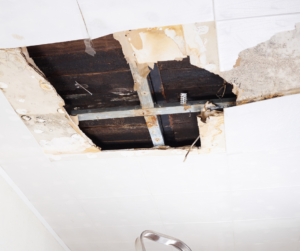
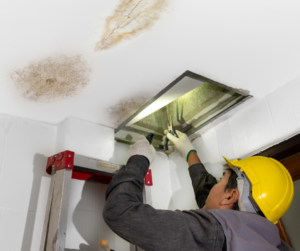
Once water bypasses the timber framework, it settles onto the top of your ceiling boards. Modern rhinoboards and plaster ceilings act like giant sponges. They absorb moisture until they reach a breaking point.
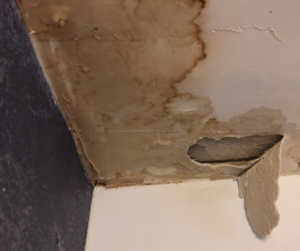
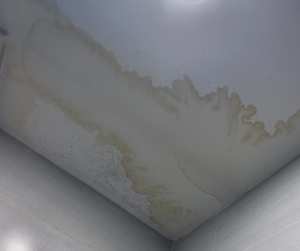
- The Warning Signs: You will first notice unsightly brown water stains, bubbling paint, or a distinct sagging in the center of the ceiling.
- The Ultimate Risk: A saturated ceiling board becomes incredibly heavy. Without warning, the entire ceiling can collapse into your living room, office, or bedroom. This doesn’t just destroy the ceiling itself; it ruins your flooring, electronic equipment, furniture, and poses a severe physical safety risk to anyone standing beneath it.
Phase 3:
Toxic Mold and Health Hazards
Moisture trapped inside your roof and walls inevitably triggers the growth of toxic black mold (Stachybotrys chartarum). Mold spores travel through your property’s air vents and ceiling gaps, severely compromising your indoor air quality. This can lead to chronic respiratory issues, asthma flare-ups, and severe allergic reactions for your family or tenants. Professional mold remediation is a complex, invasive, and incredibly expensive process that requires specialized chemical treatments.
Phase 4:
Fire Risks and Electrical Failures
Water is a natural conductor of electricity, and your roof cavity houses the core electrical wiring of your property. When water leaks drip onto exposed wiring, light fittings, or junction boxes, it triggers immediate short circuits. At best, this continually trips your prepaid meter or distribution board. At worst, it creates a severe electrical fire hazard that could put your entire property at risk.
3. Subsystem Breakdown:
Where Your Roof is Most Vulnerable
A roof is not a single, solid object. It is a highly complex, interconnected network of different building materials and structural subsystems. To properly maintain your asset, you must know exactly where the most common failure points occur.
| Roof Subsystem | Primary Function | Common Failure Mechanism | Long-Term Consequence |
|---|---|---|---|
| Flat Concrete Slabs | Modern architectural design, patio spaces. | Failed lap joints, UV cracking, water ponding. | Rising damp, structural concrete spalling. |
| Pitched Tiled Roofs | Efficient shedding of rainwater via gravity. | Cracked ridge mortar, slipped or broken tiles. | Mass underlay rotting, internal ceiling dampness. |
| Metal IBR Sheeting | Lightweight, highly durable industrial cover. | Perished washers, rust, lifting fasteners. | Corroded iron sheets, large internal leaks. |
| Valley Linings | Funneling high water volumes to gutters. | Accumulation of leaves, twigs, and hail debris. | Overflown valleys dumping directly into the ceiling. |
| Parapet Walls | Architectural borders and fire barriers. | Cracking on the plaster top cap (coping). | Water soaking downward into structural brickwork. |
4. The Pitfalls of “Quick-Fix” DIY and Cheap Contractors
When faced with a roofing issue, it is incredibly tempting to buy a cheap tin of DIY rubberized paint or hire an unverified “bakkie builder” who promises a rock-bottom price. In the roofing industry, however, cheap work always results in paying twice.
Why Over-the-Counter DIY Acrylics Fail
Most consumer-grade waterproofing products sold at local hardware stores are basic acrylic-based liquids. While they work well for a temporary patch, they lack the structural elasticity and UV stabilizers required to survive a Gauteng climate long-term. Within a single season of thermal shock, the DIY patch will crack, pull away from the substrate, and allow water to slip right back underneath.
The Danger of Ignoring Root Causes
A common mistake made by inexperienced contractors is applying waterproofing directly over an active problem without preparing the surface. For instance, if a flat concrete roof does not have the correct fall (slope) to guide water to the outlets, water will pool and stand on the slab.
Applying rubberized paint over standing water is completely useless; the ponding water will quickly delaminate the coating. A true professional knows that you must solve the structural drainage issue or apply a heavy-duty Torch-On Bitumen Membrane that is specifically designed to handle standing water.
[DIY Surface Patching] ──►
Fails to solve underlying drainage issues
──► Water pools underneath
──► Total system failure within months..

5. The Professional Blueprint:
Modern Solutions That Actually Last
To secure your property for the long run, you need to match the specific roofing problem with an engineered, professional-grade solution.
1. High-Performance Torch-On Waterproofing (For Flat Roofs)
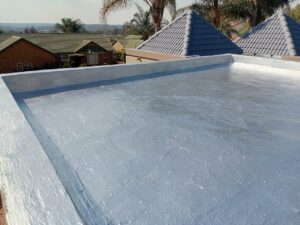
For concrete flat roofs, balconies, and complex decks, Torch-On Bitumen Membranes are the undisputed industry standard. This process involves a multi-layer, polyester-reinforced bitumen sheet that is literally heat-fused onto the concrete substrate using an open-flame torch.
- The Result: It creates a completely seamless, thick, impenetrable, and highly flexible waterproof barrier that can withstand standing water, UV rays, and extreme building movement for 10 to 15+ years.
2. Premium Roof Painting and Elastomeric Coatings
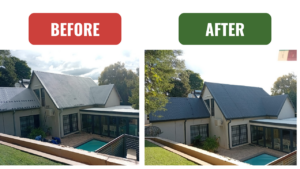
Painting a pitched tiled or iron roof is not just about making your house look attractive; it is a vital maintenance step. Premium, professional roof coatings are formulated with high-build elastomeric polymers. These coatings act like a flexible protective shield that fills hairline cracks, reflects harsh UV radiation, and stretches smoothly during daily thermal expansion.
3. Seamless Gutter System Installations
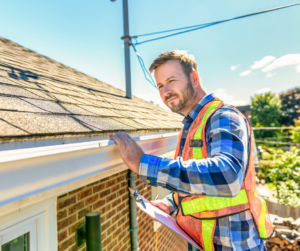
Traditional gutters feature joined sections held together with rivets and silicone sealant. Over time, thermal movement pulls these joints apart, creating constant leaks that rot your timber fascia boards.
The modern solution is Seamless Gutters. These are rolled out on-site from a specialized machine using a single, continuous strand of pre-painted, corrosion-resistant aluminum or steel. Because there are no joints along the lengths, there are zero places for leaks to form, ensuring massive water masses from Highveld storms are safely funneled away from your foundations.
4. Isotherm Insulation and Ceiling Restorations
If your roof has leaked for years, your interior climate control is likely compromised. Combining structural roof repairs with new ceiling installations and Isotherm Insulation creates a complete thermal barrier. Isotherm works by regulating your home’s temperature—trapping heat inside during our freezing winter nights and deflecting intense summer heat. This saves you thousands of Rands in monthly electricity and heating bills.
6. Your Preventative Maintenance Checklist
To protect your wallet from emergency repairs, implement this simple preventative checklist twice a year (ideally in Autumn before the winter frost, and in Spring before the first rains):
- Clear the Gutters: Remove all dead leaves, silt, and bird nests from your gutters and downpipes to prevent water blockages.
- Inspect the Flashing: Check the sealing around high-risk junctions like chimneys, skylights, and parapet walls.
- Look for Missing Mortar: Examine the ridge caps of tiled roofs to ensure the cement bedding isn’t cracking or crumbling away.
- Scan for Fastener Rust: On metal roofs, look for rusty roofing screws or missing rubber washers.
- Check the Ceiling: Periodically look up inside your rooms for faint yellow or brown water rings, or peeling paint.

Partner with Gauteng’s Trusted Roofing Authority:
Top Roof Waterproofing.
Top Roof Waterproofing stands proudly as Gauteng’s premierroofing and waterproofing specialist.
Whether you need a heavy-duty torch-on installation for a flat concrete deck, comprehensive roof painting, seamless gutter installations, or brand-new ceilings, our highly experienced teams get the job done right the first time.
Best of all, we back all of our waterproofing and painting work with an ironclad 5-year guarantee, giving you total peace of mind.
Don’t wait for the next heavy Highveld thunderstorm to test your roof.
Top Roof Waterproofing offers completely free onsite quotes and comprehensive roof inspections delivered straight to you within 24 hours!
Contact Top Roof today via call or WhatsApp at 067 2476 524, or email them at info@toproofwaterproofing.co.za to secure your free assessment and
protect your property today.
In Summary:
What We Have Discussed…
Ignoring minor roof issues under Gauteng’s harsh climate leads to a costly chain reaction of structural timber rot, ruined ceilings, mold growth, and massive financial bills.
By reading this blueprint,
what we have discussed highlights how local “thermal shock” and violent
Highveld storms systematically attack your property’s weakest points.
We covered everything from cracked ridge mortar on tiled roofs and perished washers on metal sheets to failing flat-roof seals and blocked valley linings.
True asset protection requires moving away from short-lived, brittle DIY patches and investing in professional, engineered solutions such as:
Heavy-duty Torch-On membranes,
Seamless Gutters, robust barge/fascia boards,
Isotherm insulation,
and high-stretch elastomeric roof coatings to safely seal your building,
regulate internal temperatures, and preserve your real estate value for years to come.

Free Quotes and Roof Inspections All Over Gauteng. Thanks for reading our blog.